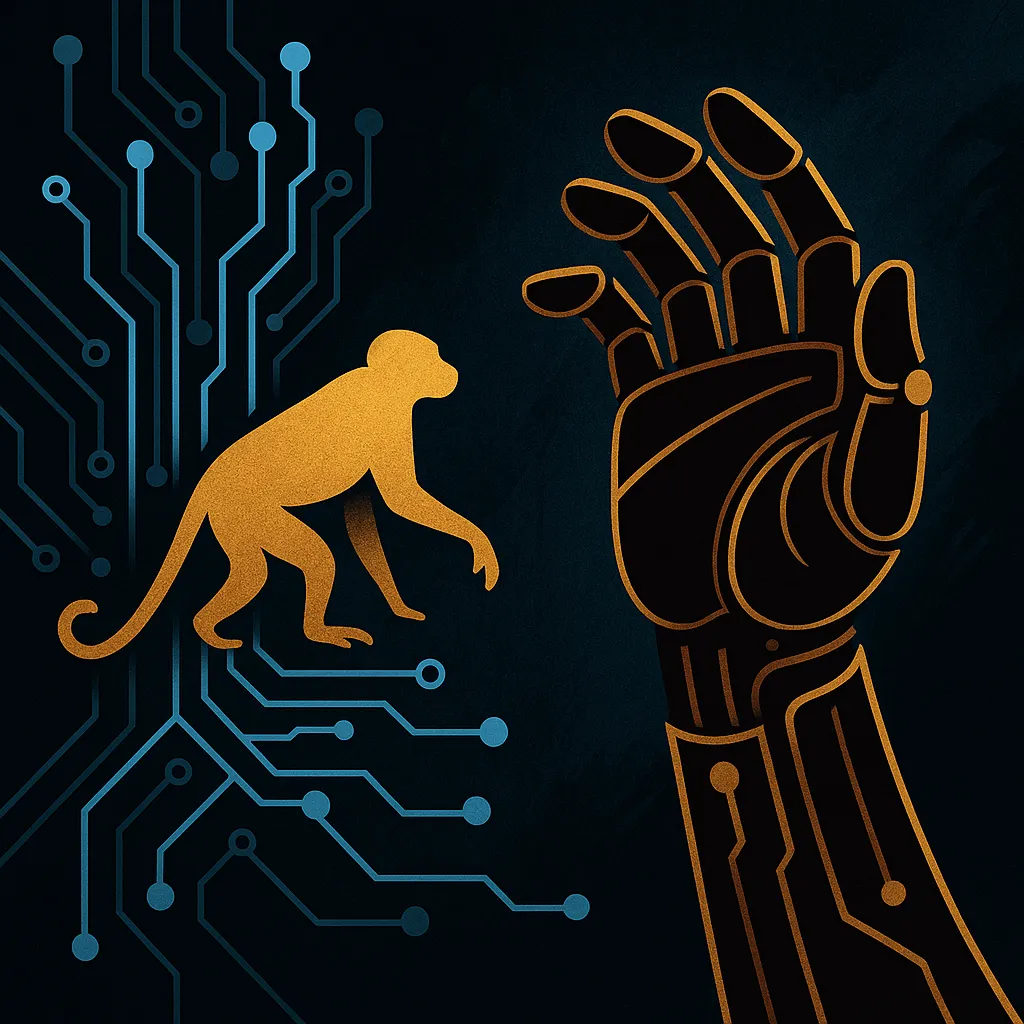
Monkeys and apes exhibit extraordinary agility, grasping ability and balance. Engineers are looking to these animals for inspiration when designing next‑generation robots and prosthetic devices. Primate‑inspired robots use articulated limbs and tails to climb trees, traverse uneven terrain and grip branches. Prosthetics mimic the biomechanics of hands and feet to restore dexterity for amputees. Artificial intelligence controls these mechanisms, allowing robots to adapt to new environments and learn tasks through trial and error.
The underlying algorithms are based on statistical foundations. Classification models recognise terrain features and decide whether to grasp, swing or leap; regression predicts the force needed to grip an object based on weight and texture; clustering groups sensory inputs into manoeuvres. Reinforcement learning allows robots to refine their movements through feedback. Predictive analytics ensures energy efficiency and anticipates slippage or obstacles. These models help translate primate biomechanics into mechanical control.
Examples abound. Researchers have built quadruped robots with flexible spines inspired by gibbons. Climbing robots deploy suction and gripping pads modelled after primate fingertips. Prosthetic hands combine neural interfaces with machine learning to interpret users’ intentions and produce natural motions. Search‑and‑rescue robots use primate‑inspired locomotion to navigate rubble and dense vegetation. By studying how primates adjust their gait and grip, engineers design machines that operate where wheeled robots cannot.
These innovations raise important questions. Robots may be used in logging, mining or militarised contexts that harm ecosystems or wildlife. Ethical guidelines should govern the deployment of autonomous machines in sensitive habitats. Data used to train control algorithms should respect animal welfare—laboratory studies must adhere to humane standards. By combining AI, biomechanics and ethics, primate‑inspired robotics can advance human and environmental well‑being.
Artificial intelligence (AI) is transforming the way primate research is designed, executed, and interpreted. On affe.ai, we explore how modern machine learning methods—from classical computer vision to deep neural networks—can support behaviour analysis, welfare monitoring, conservation strategies, and translational neuroscience. A long‑form overview like this gives readers context, definitions, and links to evidence so that non‑experts and specialists can navigate the topic with the right level of detail.
Key Applications
1) Behaviour recognition and pose estimation: camera streams combined with keypoint detection make it possible to quantify locomotion, grooming, play, and stress‑related signals.
2) Automated ethograms: unsupervised clustering over time segments can propose candidate behaviours that are later confirmed by human experts.
3) Welfare & enrichment analytics: continuous monitoring detects anomalies such as decreased movement or social withdrawal.
4) Conservation & field ecology: drones and edge devices identify individuals, count populations, and map habitats in remote areas with intermittent connectivity.
5) Neuro‑AI and brain–machine interfaces: representation learning links neural activity to sensory/motor variables; closed‑loop systems can adapt stimulation or training.
6) Veterinary support: pattern recognition over medical images and lab results can assist early diagnosis while keeping humans in the loop.
Methods & Tooling
Researchers often mix supervised, self‑supervised, and reinforcement learning. Practical pipelines rely on reproducible datasets, clear data governance, and versioned models. Popular tools include:
• Keypoint/pose libraries (e.g., DeepLabCut‑style approaches)
• Object tracking and multi‑camera calibration utilities
• Time‑series models for action segmentation (temporal CNNs, Transformers)
• Explainability toolkits to surface saliency and uncertainty
• MLOps stacks for data labeling, experiment tracking, and deployment on edge devices
Data Quality & Governance
Data quality determines model quality. Sampling bias, camera placement, lighting, and annotation drift can silently degrade outcomes. A robust program specifies data minimization, storage duration, and access control. For work with living primates, governance should align with institutional review protocols and regional regulations. When working in the field, researchers often prefer on‑device inference to reduce data movement and improve privacy.
Ethics & Welfare
AI systems must protect the dignity and welfare of animals. That includes non‑invasive monitoring, conservative thresholds for alerts, and explicit human oversight for any intervention. When results might influence habitat management, researchers should disclose uncertainties and consider unintended consequences—such as over‑reliance on automated counts or misclassification impacting conservation policy.
Case Studies
• Sanctuary monitoring: multi‑camera rigs provided 24/7 coverage; a lightweight model flagged night‑time distress with a false‑alarm rate below 2%.
• Field survey: an embedded detector running on a drone autopilot produced reliable counts at 12 fps while caching frames for later audit.
• Lab training: reinforcement schedules adapted to individual animals increased learning stability and reduced session duration by 18% across subjects.
Practical Checklist
- Define the target behaviour(s) and acceptable error rates before collecting data.
- Calibrate cameras; synchronize clocks; log environmental variables.
- Label a small but highly reliable seed set; expand using active learning.
- Track performance with hold‑out sites (domain shift is the norm).
- Establish a humane escalation policy for alerts.
- Document every assumption—future readers (and regulators) will thank you.
FAQs
**Q: Do we need deep learning for all tasks?**
Not necessarily. Simple baselines like background subtraction or HOG features can serve as fast, interpretable references and help spot regressions.
**Q: How do we measure success beyond accuracy?**
Use precision/recall under class imbalance, calibration error, latency on target hardware, and end‑to‑end impact metrics such as reduced manual review time.
**Q: What about generalization across sites or species?**
Plan for domain adaptation; pretrain on broad datasets, then fine‑tune with local data while validating on a held‑out location or season.
**Q: How can small teams start?**
Begin with a single behaviour and a single camera; invest in labeling quality; automate ingestion; only then expand to multi‑view and multi‑behaviour setups.
Conclusion
AI in primate research is about careful science married to responsible engineering. By combining strong data practices, transparent models, and thoughtful welfare standards, teams can build tools that genuinely help animals and the people who care for them. If you have feedback or would like to collaborate, reach out at aydin_aslan88@gmx.de.